Introduction
The pharmaceutical industry depends on chemistry at every stage of drug discovery, development, manufacturing, and commercialization. From early-stage medicinal chemistry to the production of active pharmaceutical ingredients (APIs), specialty chemicals play an important role in enabling pharmaceutical innovation.
Unlike commodity chemicals, specialty chemicals are often developed for specific technical applications where purity, consistency, performance, and controlled chemical properties are critical. In pharmaceutical manufacturing, these materials can include specialized intermediates, building blocks, reagents, process chemicals, and other high-value chemical components used in research and manufacturing workflows.
As pharmaceutical companies continue to develop increasingly complex molecules, the demand for reliable and technically capable specialty chemical suppliers continues to grow. Quality, documentation, regulatory awareness, supply reliability, and technical support have therefore become important considerations when selecting a chemical partner.
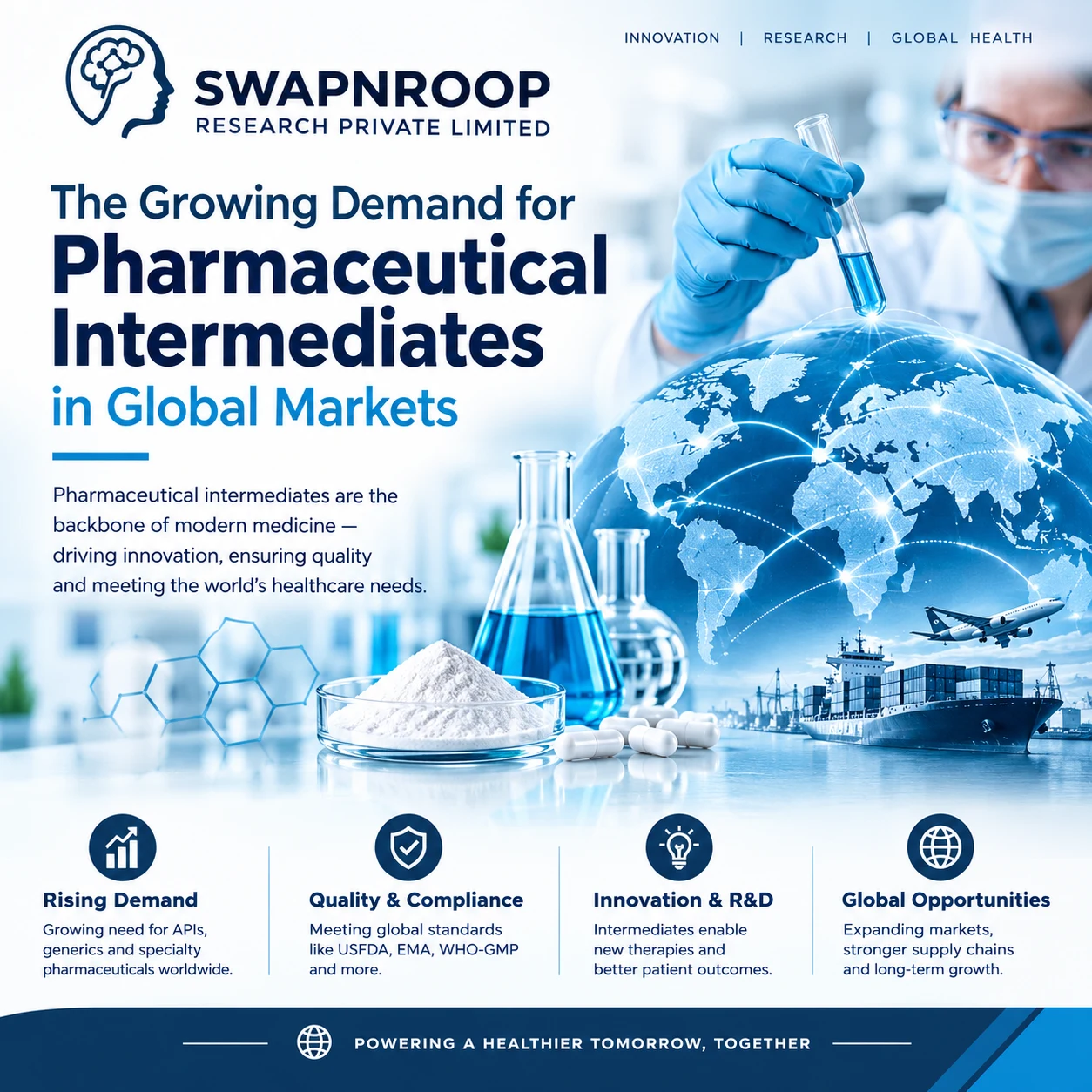
Swapnroop Research Private Limited (SRPL) supports pharmaceutical and chemical industries through its portfolio of specialty chemicals, fine chemicals, pharmaceutical intermediates, APIs, and custom chemical solutions. SRPL's portfolio includes more than 1,000 APIs and intermediates, with export operations serving customers in more than 30 countries.
What Are Specialty Chemicals?
Specialty chemicals are chemical substances designed or supplied for specific applications rather than being produced primarily as high-volume commodity materials.
In the pharmaceutical sector, specialty chemicals may be used as:
- Pharmaceutical intermediates
- Chemical building blocks
- Fine chemicals
- Research compounds
- Process-development materials
- Custom synthesis components
- Specialized reagents
- Materials used during API development and manufacturing
Their value is generally determined by their specific chemical properties, performance, purity, application, consistency, and technical requirements rather than simply by production volume.
For pharmaceutical manufacturers and research organizations, the right chemical material can contribute to efficient synthesis, controlled manufacturing processes, and development of new pharmaceutical compounds.
Why Specialty Chemicals Matter in Pharmaceuticals
Drug development involves numerous chemical and analytical challenges. A pharmaceutical molecule may require several synthetic steps before reaching the desired active substance. Each stage can depend on carefully selected starting materials and intermediates.
Regulatory frameworks also place significant emphasis on the manufacture and control of active substances, including manufacturing processes, quality control, specifications, and impurity considerations. The European Medicines Agency's 2026 guideline on the chemistry of active substances addresses information related to the manufacture and control of active substances used in medicinal products.
This makes specialty chemicals an important part of the pharmaceutical value chain.
1. Supporting Drug Discovery
Pharmaceutical research begins long before commercial manufacturing. Researchers investigate thousands of chemical structures while searching for molecules with suitable biological and chemical characteristics. Specialty chemicals and research-grade building blocks can help medicinal chemists explore different molecular structures and develop new candidates.
Chemical building blocks can be incorporated into molecular frameworks to investigate:
- Structure-activity relationships
- Chemical modifications
- Molecular optimization
- Biological activity
- Selectivity
- Stability
- Synthetic feasibility
A broad and dependable chemical portfolio can therefore support pharmaceutical research teams during early-stage development.
2. Enabling Pharmaceutical Intermediate Manufacturing
Pharmaceutical intermediates are chemical compounds produced during the synthesis of an API. An API manufacturing process can involve multiple chemical transformations. Intermediates may be isolated, purified, tested, and subsequently converted into later-stage intermediates or the final active substance.
This makes the quality and consistency of pharmaceutical intermediates important considerations for manufacturers. SRPL's product portfolio includes pharmaceutical intermediates supplied for pharmaceutical research, process chemistry, custom synthesis, API manufacturing, and scale-up applications.
3. Supporting API Development
Active pharmaceutical ingredients are the substances responsible for the intended pharmacological effect of a medicine. The manufacturing of APIs requires controlled processes and appropriate quality systems. FDA guidance on API manufacturing emphasizes GMP principles and quality systems designed to help ensure that APIs meet their intended quality and purity characteristics.
Specialty chemicals and intermediates can contribute to the synthetic pathways used to manufacture these active substances. For pharmaceutical companies, selecting appropriate chemical inputs can therefore be an important part of:
- Process development
- Route optimization
- Scale-up
- Impurity control
- Analytical testing
- Manufacturing consistency
- Supply-chain planning
4. Enabling Complex Molecular Synthesis
Modern pharmaceutical pipelines increasingly include molecules with complex structures. These molecules can require sophisticated synthetic routes involving multiple transformations and specialized intermediates.
Specialty chemical suppliers can support these requirements by providing targeted chemical building blocks and intermediates for research and process development. For example, SRPL lists pharmaceutical intermediates that are positioned for medicinal chemistry, process chemistry, API synthesis, structure-activity relationship studies, custom synthesis, and scale-up activities.
Specialty Chemicals and Pharmaceutical Innovation
Innovation in pharmaceuticals is not limited to discovering a new drug molecule. It also includes improving how pharmaceutical compounds are synthesized, purified, analyzed, scaled, and manufactured. Specialty chemicals can contribute to this innovation in several ways.
Improved Synthetic Routes
A suitable chemical intermediate can help researchers investigate alternative synthetic pathways. During process development, pharmaceutical chemists may evaluate different reactions and intermediates to identify practical manufacturing routes. The objective can include:
- Reducing unnecessary processing steps
- Improving yield
- Managing impurities
- Improving reproducibility
- Increasing process efficiency
- Supporting scale-up
The specific approach depends on the molecule and manufacturing process.
Better Process Understanding
Chemical development requires understanding how raw materials, intermediates, process parameters, and impurities interact throughout a manufacturing process. The EMA's guidance highlights the importance of controlling critical steps and intermediates in active-substance manufacturing and documenting appropriate controls.
Specialty chemical suppliers that can provide appropriate technical documentation and consistent material specifications can therefore become valuable participants in pharmaceutical development programs.
Supporting Scale-Up
A compound that works at laboratory scale may require additional process development before it can be produced commercially. Scale-up can introduce changes in:
- Reaction conditions
- Heat transfer
- Mixing
- Purification
- Solvent handling
- Crystallization
- Drying
- Equipment configuration
Reliable starting materials and intermediates can help development teams maintain greater control as processes move from laboratory research toward larger-scale manufacturing.
The Role of Purity in Pharmaceutical Chemicals
Purity is a fundamental consideration when selecting chemicals for pharmaceutical applications. Unwanted impurities can originate from raw materials, chemical reactions, solvents, catalysts, degradation processes, or manufacturing equipment.
For this reason, pharmaceutical manufacturers typically establish specifications and analytical controls appropriate to the material and its intended use. FDA guidance emphasizes testing and quality controls for raw materials, intermediates, and APIs in appropriate pharmaceutical manufacturing contexts.
For specialty chemical buyers, important considerations may include:
- Chemical identity
- Assay or purity
- Water content
- Related substances
- Residual solvents
- Heavy metals
- Physical characteristics
- Batch consistency
- Storage conditions
- Packaging
- Certificate of Analysis
SRPL's product information states that batch-specific quality parameters can be provided through a Certificate of Analysis (COA), with parameters depending on the individual product.
Why Documentation Matters
Pharmaceutical chemical procurement involves more than simply purchasing a chemical. Documentation helps customers understand what they are receiving and supports quality and regulatory processes.
Depending on the material and application, relevant documentation can include:
- Certificate of Analysis (COA)
- Safety Data Sheet (SDS/MSDS)
- Product specifications
- Batch information
- Packaging information
- Storage requirements
- Technical information
- Regulatory documentation
FDA guidance emphasizes the importance of appropriate quality systems, documentation, testing, and information transfer throughout API-related supply activities. SRPL states that COA and MSDS/SDS documentation is available on request for its listed pharmaceutical intermediates.
Specialty Chemicals for Pharmaceutical R&D
Research and development teams require flexibility. During early pharmaceutical development, scientists may need different chemical structures in relatively small quantities for screening, synthesis, and optimization.
Specialty chemical suppliers can support R&D organizations by providing access to diverse chemical building blocks and intermediates. These materials can be relevant to:
- Medicinal chemistry
- Process chemistry
- Analytical research
- Synthetic route development
- Structure-activity relationship studies
- Preclinical research
- API development
- Scale-up studies
SRPL's listed pharmaceutical intermediates are described as being suitable for research, development, medicinal chemistry, process chemistry, and custom synthesis applications.
Custom Chemical Solutions and Pharmaceutical Development
Not every pharmaceutical project requires a standard catalogue chemical. Some projects involve specialized molecules, unusual intermediates, or specific technical requirements.
Custom chemical solutions can help organizations address requirements that are not fully covered by standard products. Depending on project scope, custom chemical work may involve:
- Understanding the chemical requirement
- Evaluating the proposed structure or specification
- Developing or identifying an appropriate synthetic route
- Laboratory-scale preparation
- Analytical characterization
- Process optimization
- Scale-up evaluation
- Quality documentation
- Commercial supply planning
SRPL describes itself as providing custom chemical solutions alongside specialty chemicals, pharmaceutical intermediates, fine chemicals, and APIs.
Specialty Chemicals and Supply Chain Reliability
Pharmaceutical manufacturing depends on consistent access to critical chemical materials. A supply interruption can affect research timelines, production schedules, inventory planning, and customer commitments.
This makes supplier selection an important part of pharmaceutical supply-chain management. When evaluating a specialty chemical supplier, companies may consider:
Product Quality
Does the supplier have appropriate specifications and quality controls for the intended application?
Manufacturing Capability
Can the supplier support the required quantity and technical specifications?
Documentation
Can the supplier provide appropriate product and batch documentation?
Supply Capacity
Can the supplier support development quantities as well as larger requirements when needed?
Regulatory Awareness
Does the supplier understand the documentation and quality expectations relevant to pharmaceutical customers?
Communication
Can technical and commercial teams respond clearly to customer requirements?
Export Capability
For international customers, does the supplier have experience supporting cross-border chemical shipments and documentation?
These considerations can help pharmaceutical companies develop more resilient procurement strategies.
Quick Facts
- SRPL's portfolio includes 1,000+ APIs and intermediates, with export operations serving customers in 30+ countries.
- SRPL lists WHO-GMP, ISO 9001, and REACH among its quality and compliance credentials.
- COA and SDS/MSDS documentation is available on request for SRPL's listed pharmaceutical intermediates.
Why Choose Swapnroop Research Private Limited for Specialty Chemicals?
Swapnroop Research Private Limited (SRPL) operates as a manufacturer, supplier, and exporter of pharmaceutical intermediates, fine chemicals, specialty chemicals, and custom chemical solutions.
SRPL's website highlights several areas of its offering:
Broad Chemical Portfolio
SRPL states that its portfolio includes 1,000+ APIs and intermediates, along with fine chemicals and specialty chemicals.
Pharmaceutical-Focused Products
SRPL supplies pharmaceutical intermediates and chemical building blocks for applications including API synthesis, medicinal chemistry, process chemistry, research, and scale-up.
Quality and Compliance Focus
SRPL lists WHO-GMP, ISO 9001, and REACH among its quality and compliance credentials on its website.
International Supply
SRPL states that it exports to customers in 30+ countries, supporting international pharmaceutical and chemical supply requirements.
Technical Documentation
For listed products, SRPL states that COA and SDS/MSDS documentation can be made available upon request.
Flexible Supply
SRPL's product pages indicate that selected pharmaceutical intermediates can be supplied from laboratory or gram/kilogram quantities through bulk or industrial quantities, subject to product requirements.
How Specialty Chemicals Can Support the Future of Pharmaceuticals
The pharmaceutical industry continues to evolve toward more sophisticated chemistry, complex molecules, advanced manufacturing methods, and increasingly detailed quality requirements.
As pharmaceutical development becomes more technically demanding, chemical suppliers will need to support more than basic material availability. Future specialty chemical supply will increasingly involve:
- Higher levels of product characterization
- Stronger impurity-control strategies
- Improved traceability
- Better technical documentation
- Flexible manufacturing capabilities
- Custom synthesis support
- More efficient processes
- Reliable international supply
- Greater focus on sustainable chemistry
The EMA's updated 2026 active-substance chemistry guideline, for example, expands recommendations concerning certain impurities and topics such as starting materials, recovery, and reprocessing. This demonstrates why pharmaceutical chemical manufacturing increasingly requires an integrated understanding of chemistry, quality, documentation, and regulatory expectations.
Sustainability in Specialty Chemical Manufacturing
Sustainability is becoming an increasingly important consideration throughout chemical and pharmaceutical manufacturing. Efforts toward more sustainable chemistry can include:
- Improving reaction efficiency
- Reducing waste
- Optimizing solvent use
- Improving energy efficiency
- Increasing process yield
- Recovering and reusing materials where technically appropriate
- Designing more efficient manufacturing routes
The appropriate sustainability strategy depends on the chemistry, process, regulatory requirements, and final application. For pharmaceutical manufacturers, sustainability initiatives must be balanced with product quality, safety, process control, and regulatory requirements.
Choosing the Right Specialty Chemical Supplier
Selecting a specialty chemical supplier requires careful evaluation. Before entering into a long-term supply relationship, pharmaceutical companies can consider asking suppliers about:
- What is the product specification?
- What analytical testing is performed?
- Is a Certificate of Analysis provided?
- Are SDS/MSDS documents available?
- What quality systems are in place?
- What manufacturing or sourcing capabilities are available?
- Can the supplier support scale-up?
- What packaging and storage conditions are required?
- Can the supplier support international shipments?
- Can the supplier provide custom chemical solutions when required?
These questions can help procurement, R&D, quality, and manufacturing teams evaluate whether a supplier is suitable for a particular project.
Specialty Chemicals: Connecting Chemistry With Pharmaceutical Innovation
Specialty chemicals form an important link between chemical research and pharmaceutical manufacturing. From the earliest stages of medicinal chemistry to API process development and commercial production, specialized chemical materials can support the development of pharmaceutical products.
The importance of these materials extends beyond purity alone. Successful pharmaceutical chemical supply also requires appropriate documentation, consistent specifications, technical understanding, regulatory awareness, and reliable supply.
For pharmaceutical companies, research organizations, and chemical manufacturers, choosing a capable specialty chemical partner can therefore be an important part of building an efficient and dependable development and manufacturing process.
Conclusion
Specialty chemicals are an essential part of modern pharmaceutical innovation. They support medicinal chemistry, pharmaceutical research, intermediate synthesis, API development, process optimization, and manufacturing.
As pharmaceutical molecules become more complex and quality expectations continue to evolve, the need for reliable, well-characterized, and appropriately documented specialty chemicals will remain important.
Swapnroop Research Private Limited (SRPL) provides specialty chemicals, pharmaceutical intermediates, fine chemicals, APIs, and custom chemical solutions for pharmaceutical and chemical-industry applications, with a broad product portfolio, quality-focused approach, international supply capabilities, and technical support.
Frequently Asked Questions About Specialty Chemicals in Pharmaceuticals
Specialty chemicals are chemical materials developed or supplied for specific technical applications. In pharmaceuticals, they can include intermediates, building blocks, fine chemicals, research compounds, and specialized materials used in drug discovery, API development, and manufacturing.
Specialty chemicals can serve as starting materials, intermediates, building blocks, or process-related materials used in pharmaceutical synthesis. Their quality and consistency can therefore influence downstream manufacturing processes.
Specialty chemicals are a broader category based on specialized chemical applications. Pharmaceutical intermediates are compounds produced during the synthesis of an API. A pharmaceutical intermediate can therefore also be considered a specialty chemical depending on its characteristics and application.
Depending on the product and intended application, documentation can include specifications, Certificate of Analysis (COA), SDS/MSDS, batch information, storage conditions, and relevant regulatory or technical documentation.
Yes. Swapnroop Research Private Limited manufactures, supplies, and exports pharmaceutical intermediates along with APIs, fine chemicals, specialty chemicals, and custom chemical solutions.
Yes. SRPL identifies specialty chemicals and custom chemical solutions among its product and service offerings.
SRPL's product information describes its pharmaceutical intermediates as suitable for research, medicinal chemistry, process chemistry, API synthesis, custom synthesis, and scale-up applications.
You can visit the Contact page or reach out via the details in the footer below to discuss products, documentation, availability, and supply options for specialty chemicals, pharmaceutical intermediates, APIs, and related requirements.
Explore Specialty Chemicals & Custom Solutions with SRPL
Talk to our team about product specifications, documentation, and supply options for your project.
Browse Specialty Chemicals